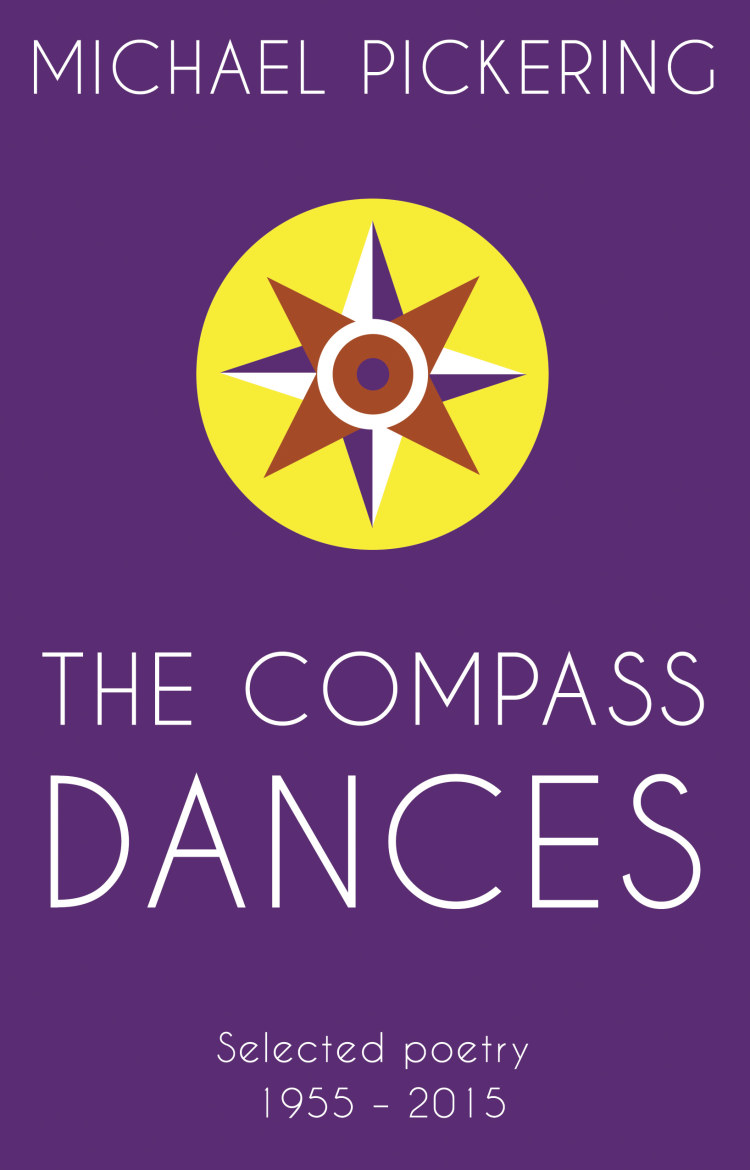
Michael Pickering has selected one hundred and sixty-nine poems (one hundred and eighty-three if you count the twenty-four sections of his long poem Cosmos as separate poems) for his self-publication The Compass Dances, representing his writing over six decades to 2015, and a lifetime's work. He is multi-voiced: there are poems in Italian and Finnish in this selection. So a poet in at least three languages, who ranges over a very wide field: people and all their doings, time and place, mysticism and the universe, nature, comedy, childhood and love.
The opening poem, MOMENT, draws many of these strands together. The title might simultaneously refer to a scientific notion, magnetic moment; to a visual mnemonic known as Fleming's right-hand rule for relating three-dimensional vectors; and to an intense experience, perhaps a waltz, shared in time by two individuals. The title yokes science and poetry together. It is not the only example: there is also, amongst others, COSMOS, an epic poem in twenty-four sections with COMMENTARY, which
describes the early history of the Universe and particularly of the Earth. The poem stands on two legs: one is current theory in cosmology and geology the other creation myth.
The threefold aspect of MOMENT never disappears number is one of Michael's preoccupations: the poem is structured in a complex argument in three sections; the Fleming Rule's three fingers become the three corners/of Earth and a reference grid for Michael's travels, for his life, grounded in physical facts Not/in the head alone. This is tight metaphysical writing, achieved in stripped-down language. The line length is meticulously judged; rhyme sparingly used. There are repeated patterns, reminiscent of oral poetry and the Psalms.
In RETURN AT DUSK ON A MOTORBIKE, which incorporates found poetry, the strained syntax (
thunder ran/is the get up and go of the grass
), kept in tension by judicious use of the line end, simultaneously enacts the hurtling speed of the motorbike and disordered nature (
rainbow
cloud
mile-gobbling thunder
get up and go of the grass
of the hill it has hurried from.). Everything in the poem's movement is held together by the notion of entropy somewhere below the surface. This is not unusual in Michael's poetry.
This is just to indicate the many voices in the collection. With tighter editing for this collection many of the poems have been individually edited and published - some of the voices and notes might not be there and the collection might have achieved a greater unity. Meanwhile, why not allow the poet to close with the ending of COSMOS
And, according to Thoth's
design, El flew
with two wings open
and two wings folded;
flew while at rest,
and rested while flying;
two that were open, and
two closed;
watched while he slept,
and slept,
while watching.