
19th June, 2026
7 min read
How to Self-Publish a Children's Book

Written by:
Hannah Cather
How to self-publish a children's book? It's a question we get a lot. Whatever path gets you to the point of publishing a children’s book can be fulfilling – whether self-publishing, traditional or otherwise. But self-publishing in particular is stand-out because of its greater levels of freedom, the miles more control, and the snug proximity an author has to the whole process – you’re not just the author, you’re the author plus close consultant to absolutely everything going on. This level of involvement and choice makes for an informed, invested, rewarding publishing experience. But how to get to that point? And how (on earth) to go about self-publishing a children’s book?
Prepping your Project before Approaching a Self-Publisher
Preparation, as with most things, is key. The proof is indeed in the prepping. Once you have your children’s book text and idea in a good place (by the way, well done – humungous achievement), the best thing you can do for your home-cooked creation is to create a neatly wrapped submission bundle. This tidy package should hold your manuscript (near final, but don’t worry too much as this is pre-editorial), a synopsis that captures the heart and essence of your tale in a couple of sentences (nothing more), a paragraph about you and the ‘story behind the story’, the age range you’re targeting, and some screenshots/inspo of illustrations that you love.
This latter point is important for a children’s book, because the illustrations world is vast and wide, and if you don’t pin down the style you’re after from the start, the poor self-publisher will be plucking ideas out of the air. Any screenshots or pictures of books are such a useful tool, creating a helpful filter and a visual guide. Doing so will show that you are aware and proactive.
With illustrations, you might be lucky enough to pick a self-publisher with an illustrations service on-site (…ahem). If not, you will need to get the illustrations completed before you submit, to add to your submissions bundle. Please note that there is a risk that illustrations from an exterior source – whether a freelancer, a friend or family member – might not be accepted by a self-publisher if they deem the illustrations to be too low-quality in format and/or style. Additionally, we've seen the rise in many submissions with AI-generated illustrations for publication. AI-generated illustrations cannot be used for publication, as they are too low quality for printers (this isn't even taking into consideration the fact that AI-generated illustrations won't be unique in style, which is crucial to help your book stand out in the competitive children's market!)
And if you want to get top marks from the submissions team and illustrator lead, break your children’s book word doc down into anticipated pages/spreads. This shows that you’re considering how the text will be distributed and how many pages there might be, which makes it easier for the publisher to imagine it as a viable and exciting new commission in real life.
What to Expect When Working with a Self-Publisher
The Flex
The good thing about going down the self-publishing route is that you will have a degree of flexibility that you just won’t see in the traditional route. But this flex is both a blessing and a (sort of, not really) curse, because it also means a lot of thinking time for you – as the author, you’ll be super involved in any decisions. The self-publishing company will metaphorically hold your hand through the process and guide you along the stages, but you will be in ultimate control.
The Cost
You should also expect that the cost will be significant. Illustrations alone mean a chunk of money, but the production and printing costs follow this. With illustrations, however, the cost quickly becomes more reasonable once you break it down and realise the monumental work of the artist – you are ultimately employing an expert freelancer for several months, utilising their time, enormous skillset and creative eye on your project. As with anything, it is best to go for quality at a cost, rather than compromising.
The Teamwork
Oh my, you’ll be pitching in. This isn’t a case of sending off a brief to an artist and getting the final art back a few months later, or throwing a manuscript at Submissions and hearing from the printers at the end of the process. Oh no. It’s instead very much a case of reviewing each stage and having eyes on all parts of the process, providing feedback about everything, and being involved and active from point A to point Z. This is full-on, but so satisfying and fulfilling.
How the Self-Publishing Process Might Go
- You might start by scoping out which self-publishers are right for you and your book. This will take a lot of research. Also, and importantly, do they have an on-site illustrations service? If not, you’ll need to find an artist and commission independently.
- Then, it’s time to get your submissions bundle ready – manuscript, synopsis, note on illustrations etc.
- If illustrations are needed, this is the first stop on the self-publishing journey (after all, you’ll need text and illustrations to start production). The team will help you through this – finding an artist, briefing them, discussing and approving artwork, and finalising the files.
- Once illustrations are in place, you will be ready for your production adventure.
- Editorial services are always a must-have, not to be missed – you might think your small word count can forego an edit, but errors can creep into the tiniest of texts particularly when ‘author blindness’ is a bit of a pandemic for anyone.
- Typesetting follows – meaning, literally, ‘setting the type’ and making the layout into something that looks like a book. This will help to make your book a near reality and is very special to see.
- Cover design – a cover illustration might already be in existence from the artist (as part of the illustrations commission). If not, a cover will be created in-house.
- Other exciting production talks include discussing book size, paper type, cover embellishments, and much more.
- Once all of the above are in place and approved, it’s time to print the book.
Pros of Self-Publishing a Children’s Book
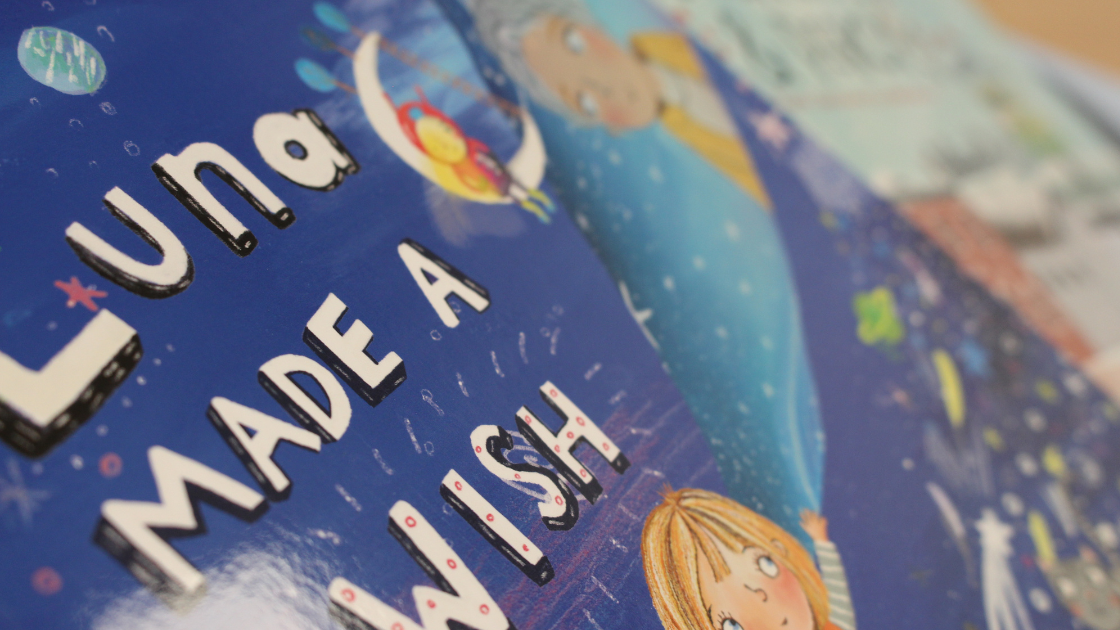
It would not be an overexaggeration to say that publishing a children’s book is pure magic in paper form. Formulating the story and concocting the images, then merging them together in a book is unmatched as an experience. And let’s be honest, when you can throw your own ideas and suggestions at the book because there is some flex available, the children’s book in question comes straight from the heart. The story is likely to have lived in an author’s head for months, even years, so why should the author not get to put their mark on the project right to the end. Printing a book that matches all of the author’s highest hopes – there’s nothing like it.
You’ll also find that the speed it takes to get from beginning to end, from first contact to final approval, is much quicker than any other route. Traditional publishing usually has much longer lead times, often years, so the pace of self-publishing is a breath of fresh air in many ways.
One huge pro that Troubador are especially forward about is that full copyright of the illustrations is handed over to the author. Troubador allows this for numerous reasons, including that the ideas from which the illustrations sprang belong to the author, the author is paying in full for the work, and because it makes the onwards journey beyond publishing much smoother and easy to navigate (there are no worries about infringement at any stage). Artists agree to this before any commissions begin and are fully credited.
Troubador and the Illustrations Service
Here at Troubador, we’re serious about self-publishing. And if you’ve written a children’s book and want to self-pub it, you couldn’t be more welcome. You’re in the right place to do justice to your text and create the book of your dreams with illustrations galore. The in-house Illustrations Service provides authors with a pool of the most fantastic artists, in a huge range of styles and with different rates (i.e. something for everyone, for every budget). The enormous task of illustrating and producing your book is broken down, streamlined, smoothened and made achievable.
How to self-publish a children’s book is a huge question, but it is also hugely exciting. You’re opening yourself up to a world of higher creative control, full and fun involvement, working at a rewarding pace, and ending up with a book that you’ve always hoped for.
The Troubador team are here to help authors in any way that we can with no obligations, so please feel free to reach out to us if you have any questions. If you need illustrations for your book cover or interiors, Troubador has a brilliant illustration service to help you find the perfect artist to fulfil your vision. We’ll look forward to hearing from you – paintbrushes, pencils and plans at the ready! Contact Hannah at illustrations@troubador.co.uk.
About the Author
Hannah Cather
Editorial and Illustration Controller
With over a decade of publishing and project-management experience, Hannah has helped to bring all kinds of books to life, including children's picture books, fiction novels, coffee-table tomes, self-help guides and more. At Troubador, Hannah splits her time between editorial (undertaking copy-edits and proofreads) and illustration (working with artists and authors to achieve beautiful illustrations). Outside work, Hannah enjoys family time, walking and (predictably) reading… or as much as four children allow!