
23rd January, 2026
11 min read
Self-Publishing an Audiobook: Top Tips from a Troubador Author

Written by:
Troubador Publishing
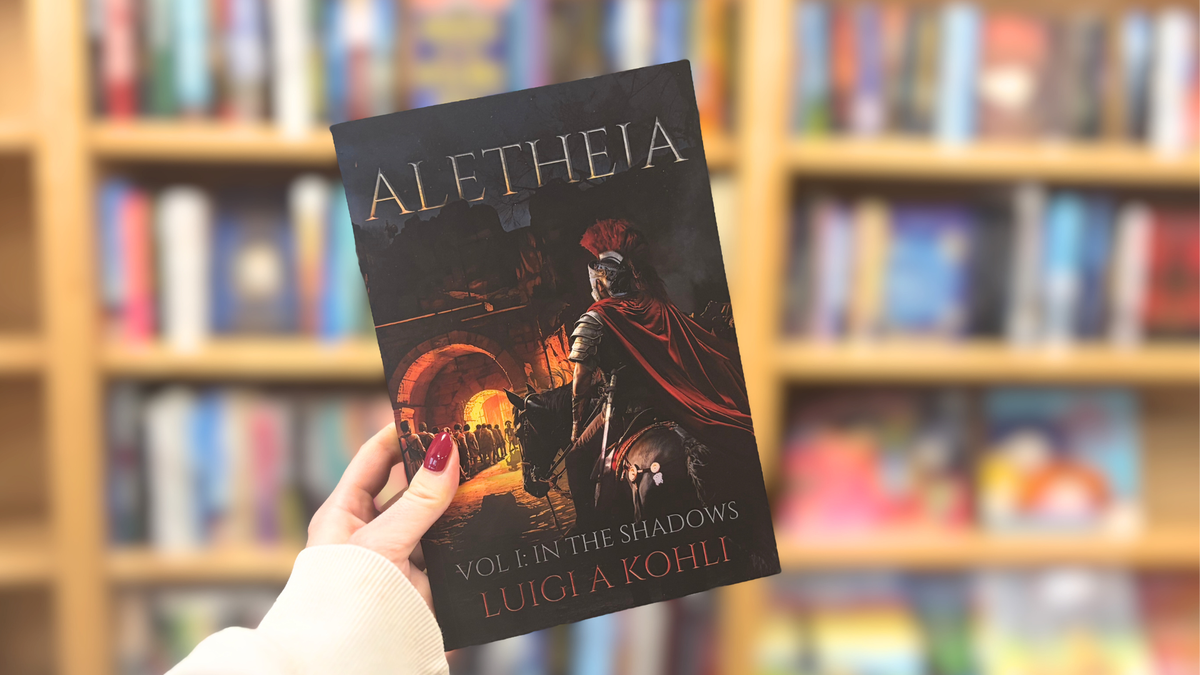
Luigi A Kohli, author of Aletheia Volume 1: In the Shadows and Aletheia Volume 2: The Binds of Fate, talks us through his experience creating an audiobook with Troubador.
Okay. So I’m published and now have two paperback books in my series. It’s a teenage ambition realised! It took nine months to gain the experience and confidence to get my book “out there” and things are looking up. I have speaking slots booked at schools, universities, clubs and institutes, and the reviews are starting to roll. Unexpectedly, I even have one from Cambridge University Press. Now what?
To Audiobook Or Not To Audiobook
It took me a while to come to the decision to do an audiobook. It had been cooking under the hood for some time, mainly because people kept asking me if my books were going to be available in this format, but two things had stood in my way.
- Cost: Anybody who has self-published knows what I’m talking about. There’s almost no limit to what you can spend to get your book noticed and, especially with your first book where you are keen to make an impact, many of us do spend more than we planned. It’s very easy to get carried away with your project. And audiobooks are not a cheap endeavour, even if the choice of narrator available to you via Troubador is impressive. More about the actual costs in a moment
- Impact: Audiobooks are a popular way to consume knowledge. Whether because one is busy, commuting, or poorly slighted, there is no doubting the convenience. My concern was with my subject matter and the style of writing I had opted to use for my biblical historical fiction. This genre is already relatively niche in the big scheme of things, and there are quite a few maps as well as charts to help the reader visualise terrain, the imperial family and also a ‘who’s who’ as there are a lot of characters. What was I going to achieve by having an audiobook as an additional format, and would it work just as well without those things?
My Decision
I had already invested substantially in marketing, social media and the rest, and though the cost of an audiobook was significant, in the bigger picture I figured “in for a penny, in for a pound”. If I wasn’t going to invest in myself on my first book, when would I? As for the maps and charts, sure they are aids for visualisation, but not ‘mandatory’ to follow the story.
I came to appreciate that audiobooks are actually quite a big deal, and for non-native English speakers it’s a popular choice. But when all was said and done, for me at least it was the narrator that clinched it! I found a voice eminently suited to a Roman epic and I could hear him speaking my very words in my head.
The fact is, everybody is different and will have their own criteria. What is important to me is not necessarily relevant to someone else, so I will not give advice on whether to do it or not. What I would say is that it should not always come down to the cold hard question of “will I break-even”. Like anything you do to promote your work, the effect of all the elements is greater than the sum of the parts. Think of audiobooks as not only a different medium with which to reach people, but also a talking point. A social media opportunity. A unique opening to a talk at a book club and so much more.
Audiobook extracts [samples] are easy to share and a great way to set the imagination alight. With the right voice on the right sample of your work, and with carefully selected music, I venture to say it could open the eyes and ears of readers you might not otherwise have reached. It creates a wow factor, a talking point. And who cares if prospective readers go on to order the paperback instead!
So now back to the 64 million dollar question. Cost. The cost is based primarily on the wordcount, with some additional expenses if you decide to add music. For most people, this means a four figure sum. If this sounds like a lot, don’t be put off just yet…
Choosing the Narrator
Troubador have a great cast of narrators to choose from, some of whom you will have heard of – Martin Carroll of World War Z (Paramount Pictures) and House of Guiness (Netflix) to mention just a few – and some not. In any event, what matters most ‘initially’ is finding a voice that aligns with the tone and landscape of your story. To help you with this, along with a small bio there is a short audiofile to listen to for each prospective collaborator you might be working with.
My story is a biblical tale set in the ancient Roman empire at a time of upheaval, corruption and constant plotting, so for me the style of language I used was an important ingredient in the spell I wanted to cast over my readers. Hence I was looking for a male voice with deep tones, perhaps familiar with the theatre and dramatic roles.
Luckily for me, I found just the right person. In fact three, but with one clear stand-out if I had a choice in the matter. As I have hinted, creating an audiobook is a collaboration, and this means that your first choice might not be as enthusiastic about your story as you are. So go into the process with an idea of who else you would be happy to work with.
The production of an audiobook is an artistic process, not a mechanical one. In much the same way as actors like to choose which scripts and roles they play, and their performances are the better for it, I think the same is true here. I am not sure if Martin would have read my book cover to cover anyway, but as I had also insisted on other artistic collaborations before this one, I wanted to work with someone who not only liked my story but truly loved it. Happily, Martin has always been a fan of historical fiction of that era, and my book hit all the right buttons for him.
Getting Started
Okay, so you’ve found the artist for your audiobook and they like your work, and you have an estimate of the costs. What then? Then it’s about understanding the timings, the process and having a discussion about our expectations as authors.
How long does it take?
If you have a specific date or season in mind for the release of your audiobook, it’s a good idea to read the freely available information from Troubador about this. For my book, which has some one-hundred-and-fifty thousand words in it, the estimated recording time was 4-6 weeks from the date at which the narrator was available. I think this is typical and a good reference point for most authors. However, you need to factor in the possibility that the narrator has a busy schedule so might not be able to start right away. Then there is your personal time to review the recordings and to provide feedback and for possible edits. To be on the safe side, my advice would be to allow 10 weeks end-to-end, plus a further 2 weeks for the upload to retailer websites.
How Does it Work?
You are given a start date for recording and a template to work with in which you can detail any amends or corrections that you spot whilst listening back to what’s been recorded. As and when chapters of your book have been narrated, these are sent to you. Troubador do this so that you don’t have to wait for the whole book to be finished before you capture mistakes or things you want to change. That there will be mistakes might sound odd, given the narrator is ‘just reading what you wrote’. But believe me when I say that, once in a flow, it’s actually moderately easy for imprecision to occur. And that is not a bad thing, as I will illustrate shortly.
Working with Troubador
Troubador have our expectations to manage. Some things are feasible, others are not going to be. In any event, you will have the opportunity to discuss your ideas with the project lead. Don’t be shy about coming forward. It’s your baby and your investment, and Troubador want the collaboration to work as much as you do.
Using Music
It’s unusual, but entirely possible, to have music included into the audiobook, either as short interludes or as headers and footers to your chapters. I think this adds considerably to the atmosphere and listening experience and, dare I give voice to the unthinkable, it’s a handy mechanism to amp the listener’s mindset to your story. However nothing is for free, so be aware that this comes at a price. Not only for the sound engineer’s time, but potentially for the music itself. You can source the track(s) you like, as I did, or provide Troubador with some ideas of what you’re looking for. Many tracks are free to use with the right credits, so don’t be put off looking into this if it’s something you are interested in. The good news is that you don’t have to make a decision on this at the start of the process.
Helpful Tips & Preparation
Here below are six key things I’ve learnt on my journey. I hope you see the merit in some of them and I would love to hear some of yours!
- Produce a list of special names or words you are particular about, with the phonetic spelling. Some narrators may request this anyway, so have one ready.
- Maintain a running document for amends. It’s easier to listen to the chapters as they come in and to note down anything you want amended, rather than doing it all at the end. It’s a lot of work, so spread it out.
- READ EVERYTHING as you listen. Mistakes happen. Even actors make ‘errors’, and besides, it’s not always about the words. Pauses are often just as important.
- Not everything you wrote needs to be said. As the listener will not have read the book, don’t be too pedantic about words missed out or if a different word is used. You will be surprised at how good things sound despite subtle differences. If it flows for the narrator, the listener won’t notice unless the meaning of the sentence is totally changed or unintended. And this brings me back to an unexpected bonus…
- Speaking aloud often brings clarity. Using post-it notes or whatever works for you, whilst listening to the audio files, take the opportunity to mark up your book with changes you would like to make to any future re-print. I took out whole paragraphs and quite a number of unnecessary words as a result of my first audiobook.
- Keep an ear out for 3 minutes (max) that sums up the style and attitude of your story or of a key protagonist, and develop a short-list to pick from later. Retailers need an audio sample for listeners and Troubador will ask you for this at the end.
Advertising Your Audiobook
When the audiobook is done, the last pieces come to the fore, but you shouldn’t wait till the end to prepare the way. Again here in shorthand, I have some ideas based on my own approach.
Using the Narrator's Platform
You shouldn’t choose the narrator based on how famous they are, but naturally, any profile they have is useful in your marketing efforts. They will be happy for you to leverage that, and to share their work within their own sphere.
Using Social Media
At present this is not an area Troubador has packaged services for, but don’t let it stop you from having a go yourself! Social media is going to help you with the audiobook which lends itself to channels your paperback cannot reach. Consider advertising with the specific platforms that specialise in audio. For example Audible, Spotify and the like. You will be surprised at just how many platforms are out there, some also supporting libraries who are always interested in audiobooks.
Audiobook Teasers of 90 Seconds or Less
Remember, you have all the audio files at your disposal. There are many easy to use and free apps available to help you create your own teasers and Troubador is happy to recommend a few. Teasers make for great social campaigns, and most platforms have tools to help you combine your audio with other media for fantastic and impactful posts.
Audio samples can also be a nice and simple way to complement a speaking engagement, book signing or book club event.
Reviews
As per paperback, there are many well-respected sources that do reviews for audiobooks. Research the best ones for you or your genre. The BBC has a scheme, called BBC Upload, where you can submit any piece of audio with the chance of it being showcased on air (radio) in your local area. It’s free to enter all year around.
The Narrator's Perspective
Martin Carroll, narrator of Aletheia - Volume I: In The Shadows
I have been an audiobook narrator for over 15 years, and I have narrated books, scripts, and other material for publishing houses such as Troubador. My background is as an actor, and my first professional engagement was way back in April 1975.
As anyone who has listened to audiobooks knows, the narrator is the bridge between an author’s imagination and a listener’s heart - they also improve accessibility to the world of literature, and that's a very powerful thing.
For advice? In a similar route to Luigi's advice, we recommend you:
- Give your narrator all the details they need: start with a little introduction about the style of the book, the main themes, genre and so on (the kind of things that are mentioned in the blurb, for instance). Make sure to also communicate if there is anything specific the author really wanted to achieve or communicate through the audiobook.
- Consider accents: do you need a specific accent for your book? If you do, make sure your narrator is confident with this accent before you go ahead, to limit any stress in the production process!
We are all trying to make it sound the best it can be, and I'm always so pleased when an author is happy with their finished audiobook.
The audiobook for Aletheia Vol.I In The Shadows is available now.