
19th December, 2025
8 min read
Everything an Author Considering Self-Publishing Should Know About Copyright

Written by:
Chloe May
Navigating copyright is one of the most important, and often most misunderstood, parts of self-publishing. Learning how copyright law protects your writing and how to legally use an extract or picture of someone else’s material is essential if you want to publish with reassurance.
In this blog we’ll explore when and what steps you should take when you need permission to use another creator’s content. Whether you’re quoting text, referencing artwork or even incorporating small pieces of inspiration, knowing your rights and the rights of others can help you avoid disputes.
Please note that there is no international standard of copyright law and all countries legislate differently. In this article we will be referring primarily to UK copyright law. Please also bear in mind that while we have generated some knowledge of copyright at Troubador Publishing, from our many years of advising authors, we are not copyright experts and we would always recommend that authors seek the advice of a permissions editor or consultant, or alternate legal advice, before proceeding.
By the end of this article, you’ll have a clearer understanding of when you can use material, when you must ask for permission and how best to safeguard your own creative efforts.
Using Others’ Work Legally
Whether you’re incorporating an extract from a source, using a picture of something or quoting a famous line, it’s your responsibility to ensure that the material is used legally and respectfully.
Song lyrics and titles
One of the most common copyright questions concerns music. Song lyrics are protected by copyright, regardless of length, and you must always request permission to reproduce them. Song titles, however, are not protected by copyright.
Web content
Just because text or images appear on a website does not mean the site owns them. Anyone can upload content without proper clearance, so you should always verify the true rightsholder. This may require a significant amount of detective work.
Characters and fictional worlds
You cannot write a new book using characters, settings or plotlines from a work still in copyright. New books based on copyrighted works cannot be commercially published without permission from the rightsholder.
Screenshots
Screenshots nearly always contain copyrighted material – logos, adverts, software interfaces, photography, text. If you plan to publish a screenshot, you must request permission from the relevant owners.
How Long Does Copyright Last?
The duration of copyright varies by medium. However, the most common areas we find self-publishing authors are considering – literary works (including song lyrics, quotations from books etc.) and artworks – both have a copyright period that lasts for 70 years following the author or artist’s death.
How to Source Permission to Use Copyrighted Materials
When sourcing permissions, you should always go first to the original material and attempt to trace the work back from there. Most large publishers of books and music will handle their own permissions process – so if it’s clear that the copyright is owned by the original publisher then they will be your best place to start. If they’re not the copyright owner, they may be able to advise you on where to go next.
As a general guidance, in fiction, the copyright generally remains with the author but the publisher will administer requests on their behalf. If a work goes out of print then the copyright generally reverts to the author, but the administration of requests may be handled by an agency or the author’s estate. In non-fiction publishing, it is more common for authors to sign over the copyright to the publisher in full – especially if they are publishing in a niche area. For self-published books, the copyright generally remains with the author and they administer their own requests. If the copyright holder is known to you personally, it may be possible to source permission through a private agreement, however you should always look to get confirmation of this in writing.
If it is less clear who the rightsholder is then there are several places to search. The internet has made searching for rightsholders infinitely easier and organisations such as the Publishers Licensing Agency (PLA) and WATCH have platforms set up to assist with copyright clearance. However, if you lack the knowledge and confidence to source permissions, or if your book requires a great volume of permissions, you can always look to hire a freelancer permissions editor to assist you.
As a general rule, you should expect to be charged for securing permission for some if not all of the copyrighted material you intend to reproduce. Therefore, if your book is dependent on a lot of copyrighted material, you should account for this in your budget for self-publishing.
Understanding Fair Dealing
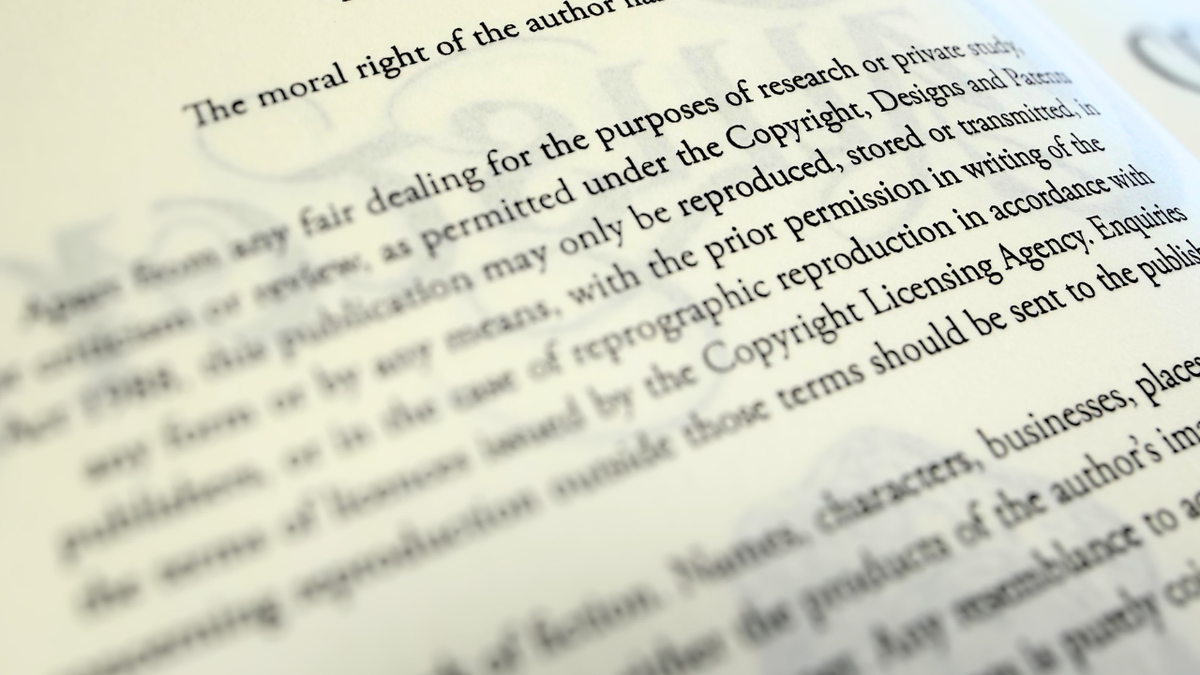
When you’re deciding whether you can use an extract of copyrighted material without asking for permission, one of the most important concepts in UK copyright law is fair dealing. Unlike the broader US idea of ‘fair use’, fair dealing is narrow, purpose-driven and carefully defined. It is not a blanket license to copy whatever you like; instead it provides a small number of legitimate reasons where you can use someone else’s work while still respecting their ownership and right to control how their material is distributed.
In UK law, fair dealing covers specific circumstances:
- Non-commercial research or private study – you may use a reasonable extract of work for your own personal learning or research, but this does not usually permit inclusion in a published book that earns royalties.
- Criticism or review – if you are analysing or discussing a work, you can quote from it within reason as long as the quoted material is relevant, not excessive and fully acknowledged.
- Reporting current events – journalists and commentators may reproduce small sections of works when reporting on something newsworthy.
- Illustration for instruction – teachers may reproduce material for teaching, again with limits.
- Parody, caricature or pastiche – creative transformations that comment on or imitate a work may fall under fair dealing, but the new piece must truly be original and not simply a substitute for the original work.
There is no fixed word count on what is the maximum that can be used under fair dealing, but the key question should always be ‘Is the amount justified by the purpose?’ Consider also that fifty words quoted from a three-hundred-word poem will be treated very differently to that from a book of eighty-thousand words. This is why there is no ‘fair dealing’ for using song lyrics without getting permission – the overall word count in a song can be so low that even just quoting one line constitutes a significant portion of the work.
The law also considers whether your use competes with the original work. If your reproduction might replace the need to consult the original, fair dealing does not apply. The bottom line is that fair dealing can allow limited, justified quotation, but it is not a loophole for avoiding gaining permission. Always consider why you’re using the material, how much you are using, whether your use harms the market for the original and whether your use is essential to your point. If you feel unsure, the safest options are to seek permission or remove the content entirely.
Whenever you use copyrighted material with permission – or under an applicable exception such as fair dealing – you must acknowledge the source. Rightsholders may specify wording or placement of the acknowledgment in your agreement with them and this must be followed exactly.
Licensing Images and Artwork for Your Book Cover
There’s no denying that using the right image or a striking piece of artwork on your front cover can give your book real impact. But images are one of the most common areas where authors unintentionally break copyright law. Every image has an owner, and that owner holds the right to decide how that image is used, reproduced or distributed. To stay on the right side of the law, you must ensure that you have the correct permissions to use any image on your front cover.
If an image is not offered under a clear license, or you found it on a website without attribution, you’ll need to track down the rightsholder and request permission. This includes photos from personal blogs or social media, artwork on social media, images used in articles or galleries, and photographs containing recognisable people, locations or trademarks. Changing an image does not make it original, and placing it on a book cover counts as a commercial use that generates royalties. This makes permissions even more important.
You have several options for obtaining cover art legally.
- Stock image libraries – you can use sites such as Shutterstock, Adobe Stock and Alamy who offer images suitable for use on book covers. At Troubador, we can help authors source suitably licensed images for their covers from a stock image library.
- Commissioned artwork – hiring an illustrator gives you a custom original piece. This is often the safest route, but make sure your arrangement clearly states who owns the copyright and what specific rights you are acquiring from the artist. We run an Illustration Service at Troubador Publishing where we work with a pool of illustrators to source artwork for self-publishing authors.
- Public domain artwork and Creative Commons-licensed images – works genuinely in the public domain can be used freely, but be careful. New photographs or new digital restorations of older artwork may still be protected. And some images are free to use under Creative Commons but each licence has rules and make sure you read the terms carefully.
Protecting Your Work
The same rules that necessitate you clearing permissions to use copyrighted material in your book are the same that protect your own work as your intellectual property. Understanding the importance of these rules ensures that your original ideas and text remain under your ownership and that you retain the right to distribute them and earn royalties.
In most countries, your work is automatically protected by copyright as soon as it is created – typed on a computer, handwritten or recorded. You do not need to register your work to own it. This means you have the legal right to reproduce your work, distribute copies, adapt or translate it, or license it to others.
There are some steps you can take to safeguard your work. We recommend that you include a copyright statement on your book’s copyright page (i.e. Copyright © 2025 [Author Name]) as this signals to readers and other creators that your work is protected. You should consider how freely you send out copies of your work and use a watermarked PDF if you’re circulating copies for endorsements or reviews. You should also make sure you use Digital Rights Management (DRM) for ebooks to prevent unauthorised copying and sharing.
Being proactive about copyright – that of yours and other creators’ – ensures that your ideas remain yours and your right to profit from your work is secure.
Your Rights and Responsibilities as an Author
Understanding copyright, knowing when to request permission and respecting the ownership of others’ work is an essential step for any self-publishing author. These same principles are what safeguards your own original material and your right to distribute it, earn royalties and maintain creative control.
By following the principles outlined, you can publish confidently, ethically and legally. Remember: when in doubt, it’s safer to seek permission, remove the content entirely or create something original.
Additional Reading
Society of Authors, ‘Copyright and permissions’
The UK Copyright Service, ‘UK Copyright Law’
The UK Copyright Service, ‘Obtaining permission to use copyright material’
About the Author
Chloe May
Operations Director
Chloe studied English Literature at Cardiff University and has extensive experience in publishing, having worked in editorial management roles at Bloomsbury and Pan Macmillan. Chloe joined Troubador Publishing and the Book Guild in 2022, originally as Publishing Manager for the Book Guild, and also worked in the Troubador Customer Services team for a period of time ahead of becoming Operations Director in 2024. In her role, Chloe oversees trade relationships, warehouse and distribution operations, and HR and operational functions, and provides support to authors, including guidance on reprints and metadata. Chloe is also one of Troubador’s Mental Health First Aiders, there for staff to talk to, and enjoys organising activities with staff to foster positive wellbeing at work.