
5th June, 2026
10 min read
The Environmental Impact of Publishing (And How Authors Can Reduce It)

Written by:
Alex Thompson
It’s no secret that the production, printing and distribution of books has an environmental impact. From paper sourcing and printing through to shipping, storage and the eventual disposal of any unsold stock, every stage of the process uses materials and energy. Even digital publishing carries its own footprint through data storage and device usage.
That said, authors shouldn’t be discouraged from sharing their work due to environmental considerations alone, especially when working alongside an environmentally conscious publisher. However, more authors are now factoring sustainability into their approach to publishing and are looking more closely at where the impact lies and what can realistically be done to reduce it.
In this article, I’ll look at the main areas where publishing affects the environment, and the practical steps both authors and publishers can take to minimise that impact while still producing and distributing work effectively.
Paper & Material Sourcing
The first and most obvious environmental impact of publishing is paper sourcing. Paper production relies on forestry, water usage and significant energy inputs. While paper (when responsibly sourced) is a renewable material, its environmental impact depends heavily on how it is sourced and processed. The difference between responsibly sourced materials and non-certified paper can be substantial, particularly in terms of forest management and supply chain transparency. For authors, sourcing is often an overlooked detail, but it plays a meaningful role in a printed book's overall footprint.
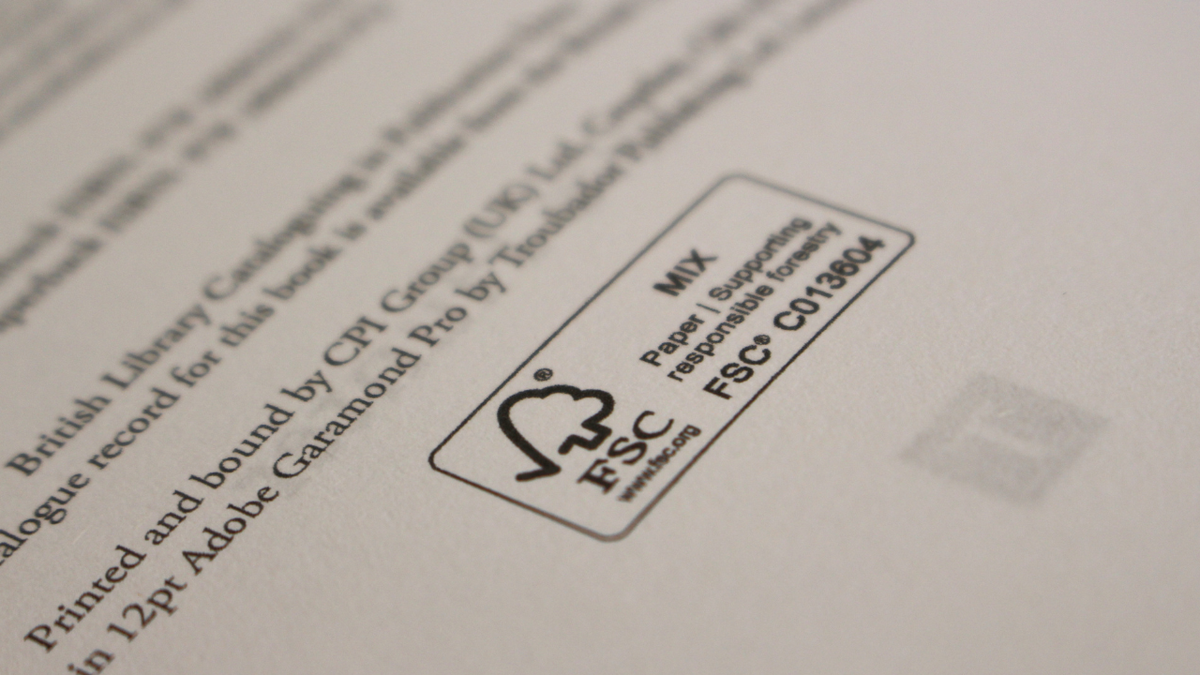
Opting for FSC-certified paper is a practical way to address this, ensuring that materials come from responsibly managed forests that meet verified environmental and social standards. It is also worth asking a publisher questions about sourcing and production standards early in the process, as these details can vary significantly between suppliers and printing partners.
Printing & Production
Printing is an energy-intensive stage of the process, involving machinery, inks and finishing processes that all require resources. One of the biggest environmental challenges here is overproduction - printing more copies than are ultimately needed. Inefficient or overly optimistic print runs can lead to waste in both materials and energy, even before a book reaches readers. That said, most authors still want their books to be printed, particularly if they are aiming for bookshop availability or physical distribution. In practice, this creates a need for balance rather than avoidance.
For authors who want to access bookshops and hold stock, short-run printing can offer flexibility in managing quantities. Smaller print runs generally use fewer raw materials upfront, but can be less energy-efficient per copy due to repeated press setup and shutdown. Larger print runs, by contrast, tend to be more energy-efficient per unit but require greater overall use of materials and carry a higher risk of surplus stock if demand is overestimated. Authors printing books through a publisher should be able to obtain guidance on where the sweet spot might be for them and their project.
For authors who are not focused on bookshop stocking or who are primarily looking to access a global audience rather than a targeted local one, print-on-demand can be an effective alternative. In this model, copies are produced only when ordered, reducing the risk of excess inventory and waste. However, because presses are frequently started and stopped, per-copy energy use can actually be higher than in traditional bulk printing, in addition to the fact that a single copy is to be shipped to the end user rather than a bulk order being delivered to a retailer. Some authors also choose a hybrid approach, using a small initial print run for personal copies or launch stock alongside ongoing print-on-demand availability.
Ultimately, there is no entirely impact-free option when it comes to printing. The key is understanding the trade-offs involved in each approach, and choosing the model that best aligns with both an author’s distribution goals and environmental considerations.
Distribution & Logistics
Once printed, books need to be transported, often multiple times, to different warehouses, retailers and end customers. This creates a carbon footprint tied directly to the logistics of every printed copy of your book. Frequent small shipments are typically less efficient than consolidated deliveries, as they require more packaging, handling and transport journeys overall. There is also a hidden environmental cost in prioritising speed and convenience over efficiency in supply chains.
For authors, some of this impact can be reduced through forward planning. When stock is required for events, launches, or bookshop placements, placing orders well in advance allows deliveries to be scheduled more efficiently. Rush deliveries, by contrast, are generally less efficient because they are prioritised through the system independently of other consignments. Planned shipments can often be combined with existing courier routes, reducing the need for dedicated journeys.
Consolidating shipments wherever possible also helps reduce unnecessary transport activity, particularly when orders are grouped rather than sent in multiple smaller batches. Planning ahead for known demand - such as events, signings, or seasonal spikes - can therefore make a practical difference in reducing logistical impact.
Working with a distributor that handles a large volume of stock on behalf of authors can further support this, as copies can often be batched and routed alongside other deliveries rather than handled in isolation. While none of these approaches removes the environmental impact of distribution entirely, they do help reduce inefficiencies within the system, which in turn reduces environmental impact.
Surplus Books & Waste Management
When books are overproduced, unsold copies often end up being recycled or pulped. While recycling is preferable to landfilling, it still requires energy, water, and processing, all of which have negative environmental impacts. In many cases, this represents avoidable waste caused by overestimating demand or running larger print quantities than ultimately needed. That said, it’s also important to recognise that forecasting demand is not an exact science, particularly for debut authors or new releases where sales patterns are harder to predict. The aim is not to eliminate surplus entirely, but to reduce it where possible through more considered planning. Carefully planning print runs based on realistic demand, pre-orders, and distribution strategy can significantly reduce this downstream impact and help ensure that fewer books are produced without a clear route to readers. Authors working with a publisher should be able to seek advice on this matter during early discussions about printing copies.
It is also worth thinking beyond the point of sale or initial distribution. Considering what happens after printing, exploring donation opportunities and aiming to extend the life of every printed book can all help reduce waste and give surplus copies a more meaningful end use than recycling or disposal. In some cases, publishers can also support this process directly by working with charities and literacy organisations to redistribute surplus stock on behalf of authors. This can include donating books to schools, reading programmes, and community initiatives where they can continue to be used and read, rather than being broken down as waste. Partnering with established organisations helps ensure that surplus copies reach audiences who will benefit from them, while also reducing the environmental impact associated with disposal.
Digital Publishing
Digital publishing removes the need for paper, printing, physical storage and shipping, as well as eliminating the need to consider surplus stock entirely. In that sense, it avoids many of the material inefficiencies associated with print production and distribution. However, it is not impact-free, a common misunderstanding. Digital books still rely on infrastructure that carries an environmental cost. Data storage and distribution depend on large, energy-intensive data centres, which require continuous power and cooling to operate. While these systems are becoming more efficient over time, they still contribute to overall energy consumption and are far more energy hungry than printing presses.
There is also the impact associated with the devices used to read digital books. E-readers, tablets and smartphones all require raw materials, manufacturing processes and global supply chains to produce. They also have a finite lifespan, meaning replacement and disposal contribute further environmental considerations. Even though a single device can store thousands of books, its production footprint remains significant and is not tied to a single title or use.
For authors, offering ebook formats can be a practical way to reduce reliance on print and the associated use of paper, ink and physical logistics. Digital publishing also provides a highly efficient way to reach international audiences without the need for shipping, warehousing or stock management across multiple regions. This can make it a useful option for ongoing availability, backlist titles, and readers who prefer digital formats.
Rather than viewing digital publishing as a direct alternative to print, it is often more effective to see it as part of a broader mix of formats. Many authors choose to publish in both print and digital forms, using each for its strengths: print for physical presence and retail distribution, and digital for reach and reduced material usage. Ultimately, digital publishing shifts the type of environmental impact rather than removing it. Understanding that distinction helps authors make more informed decisions about how they structure their publishing strategy across different formats.
Physical Communication
Another area where impact can be reduced and often is not considered is in the day-to-day communication and administrative side of publishing. Switching from paper contracts, forms, proofs, and other documentation to digital versions shared via email and online platforms, rather than sending physical copies by post, removes the material costs of those crucial steps in the publishing process. Similarly, keeping conversations within email, phone calls, and video meetings reduces the need for physical travel. While this may seem minor, reducing unnecessary car journeys and courier trips throughout the production and publishing process adds up over time, especially when multiplied across multiple projects and stakeholders.
Printed marketing materials are still valuable, but they don’t need to be produced in large quantities to be effective. Printing only what is genuinely needed, rather than bulk quantities “just in case,” helps avoid waste while still supporting events, launches, and outreach where physical materials add value.
For author copies, there is also a practical opportunity to reduce courier usage. When authors choose to receive a small number of physical copies and then distribute them to family and friends in person at their next meeting, rather than arranging immediate individual deliveries. In the meantime, readers can access the ebook version, ensuring there is no delay in engagement while avoiding unnecessary shipments.
Taken together, these small adjustments, along with others in how communication, distribution and promotion are handled, can meaningfully reduce environmental impact without limiting the effectiveness of the publishing process.
Troubador’s Approach to Sustainable Publishing
Troubador Publishing does what it can to be as sustainable as possible. We are always looking for new ways to reduce our environmental impact, and we are proud to prioritise sustainability alongside delivering high-quality end products for our authors. While authors make a number of important decisions, for those working with a publisher on their project, much of a book’s environmental impact is shaped by the publisher’s processes across production, distribution and ongoing management.
At a practical level, this includes using responsibly sourced materials, such as FSC-certified paper and working only with UK-based printers that source their materials responsibly to both reduce transport distances and ensure that our paper is sustainably sourced. Our production approach is designed to prioritise efficiency and reduce unnecessary waste, with careful print planning and forecasting helping to avoid overproduction while still ensuring books are available where and when they are needed. We also have a partnership with More Trees, which enables us to plant a tree for every single title that we publish. Each tree offsets 0.3 tonnes of CO2, helping us reduce our impact on the environment.
Distribution and warehousing are other significant factors for our approach to the environment. We operate from our own warehouse in Leicestershire, which allows us to manage stock more efficiently and consolidate deliveries into regular bulk shipments rather than fragmented or ad hoc dispatches. This helps reduce unnecessary transport movements and improves overall logistical efficiency. Alongside this, we offer meaningful alternatives for unsold copies, including donating them to charity at the end of an author’s distribution contract, if they choose to do so.
Operationally, we work in a digital-first way wherever possible. This includes electronic contracts and communications, digital proofs throughout production, and a reduced reliance on physical mailings and printed materials unless they are genuinely required. We also take steps beyond the core publishing process. Our office building is equipped with solar panels, and we have an EV charging point on site to support lower-emission transport options for our team and visitors. Even small day-to-day choices matter to us - recycling everything we can and sourcing coffee beans for the office from a local roastery on our business park, helping to reduce unnecessary transport miles associated with ordering them online from elsewhere, are just some examples.
Taken together, practices like these reflect a more considered approach to publishing, where environmental impact is not treated as a separate initiative but is built into how the entire process is run.
Rethinking Publishing and the Environment
There is no completely impact-free way to publish a book. From print and digital production through to distribution, storage and marketing, every stage of the publishing process carries some level of environmental impact. The goal is therefore not perfection, but progress - making better, more informed decisions wherever possible rather than trying to eliminate impact entirely.
Sustainable publishing is built on small, practical changes that, when applied consistently, add up to meaningful improvement over time. This might include using responsibly sourced materials, improving print planning to reduce waste, considering when digital formats are most appropriate, minimising unnecessary shipments, and shifting more communication and workflows to digital channels. Just as importantly, it requires working with partners who take these considerations seriously and embed them into their processes across production, warehousing, logistics and communication.
Ultimately, reducing environmental impact in publishing is not defined by a single decision or a perfect outcome, but by ongoing awareness and steady, considered improvements at each stage of the process. With a clearer understanding and more conscious choices, it is possible to continue producing and sharing books effectively while gradually reducing their environmental footprint.

About the Author
Alex Thompson
Managing Director
Alex is a seasoned leader with extensive experience in small and medium-sized businesses. As Managing Director of Troubador and its sister company, The Book Guild, Alex collaborates closely with both teams to drive business growth, enhance internal processes and expand opportunities for self-published authors. Passionate about innovation, Alex is always on the lookout for new technologies or processes that improve efficiency and streamline operations to give our authors the best possible publishing experience. Outside of work, Alex enjoys experimenting in the kitchen, exploring the outdoors, being out on the golf course and supporting Leicester City FC.